Travel Gear Checklist for Women Traveling Alone | Solo Travel Essentials
Traveling alone as a woman is one of the most freeing ways to see the world. You choose the pace, the neighborhood, the café, the day trip, and the moment you head back to your room. Nobody else’s schedule decides your day.
But solo travel also means you are your own backup. There is no travel partner to watch your bag while you use the restroom, no one to share a charger with, and no second pair of eyes checking the street name when you arrive late at night. The right gear does not replace good judgment, but it quietly removes a lot of small problems before they become big ones.
This checklist is organized by what each item actually does for you: keeping you safe, keeping you connected, keeping your things organized, and keeping you comfortable. Use it as a starting point and adjust it for your destination, season, and travel style.
How to Use This Checklist
Before packing anything, ask three questions about each item:
- Will I use it at least twice on this trip? If not, it probably stays home.
- Can I carry it myself, up stairs, for ten minutes? Solo travelers carry every gram alone.
- Does it solve a problem I can’t easily solve at my destination? Shampoo can be bought anywhere. A spare phone charger at 11 p.m. in a small town often cannot.
1. Personal Safety Gear
Most solo trips are uneventful in the best way. Safety gear is about confidence and options, not fear. These are small, light items that give you a little more control over your surroundings.
Personal safety alarm
A keychain alarm produces a very loud siren when you pull the pin. It is legal to carry almost everywhere, unlike sprays, and it works by drawing attention quickly. Clip it to your day bag strap, not buried inside. Test it once at home so you know how it activates and how loud it is.
Portable door lock or door stop alarm
Guesthouse and budget hotel doors are not always as secure as you would like. A portable door lock fits into the strike plate of most inward-opening doors, and a wedge-style door stop alarm sounds if someone pushes the door. Both pack flat and take seconds to set up at night.
Anti-theft day bag
Look for a crossbody or backpack with zippers that sit against your body, slash-resistant straps, and a hidden back pocket for your phone and cards. A crossbody worn in front is easier to keep an eye on in crowded markets, metros, and festivals.
Small flashlight
Your phone torch works, but using it drains the battery you may need for maps or calls. A tiny flashlight helps on dark streets, during power cuts, and on early-morning walks to bus stations.
2. Documents and Money
Losing a passport or all your cards is the single most disruptive thing that can happen on a solo trip. The goal here is simple: never keep everything in one place.
- RFID-blocking passport holder or travel wallet to keep your passport, boarding passes, and a pen together.
- A second, slim wallet with a small amount of local cash and one card for daily spending. Keep your backup card somewhere else entirely.
- Photocopies and digital copies of your passport, visa, insurance policy, and bookings, stored offline on your phone and in your email.
- Emergency contact card written on paper: a family member’s number, your accommodation address, and your embassy’s number. Phones die; paper doesn’t.
For a full pre-departure list, see our travel documents checklist before an international trip.
3. Staying Connected and Charged
When you travel alone, your phone is your map, translator, ticket, bank, and lifeline. Keeping it charged is a safety issue, not a convenience.
- Power bank (10,000mAh is a good balance) — enough for one or two full phone charges without much weight. Keep it in your carry-on; airlines don’t allow power banks in checked luggage.
- Universal travel adapter with USB ports so one plug charges your phone, power bank, and earbuds overnight.
- A spare charging cable stored in a different bag from your main one.
- Local SIM or eSIM plan arranged before you land, so you have data the moment you leave the airport.
- Offline maps of every city you’ll visit, downloaded on Wi-Fi before you go.
A small habit that helps: share your live location with one trusted person on travel days, and send a quick message when you check in somewhere new.
4. Luggage and Organization
Solo travelers benefit most from packing light. You’ll be lifting your bag onto trains, carrying it up guesthouse stairs, and keeping hold of it in bathrooms and cafés. A bag you can manage with one hand leaves your other hand free for your phone, ticket, or railing.
Carry-on sized bag
For trips of up to two weeks, a carry-on suitcase or a 35–40 liter travel backpack is usually enough. Skipping checked luggage also means no waiting at baggage claim late at night and no risk of a lost bag.
Packing cubes
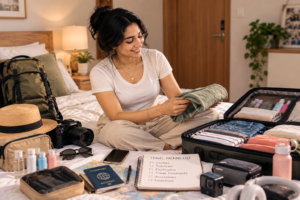
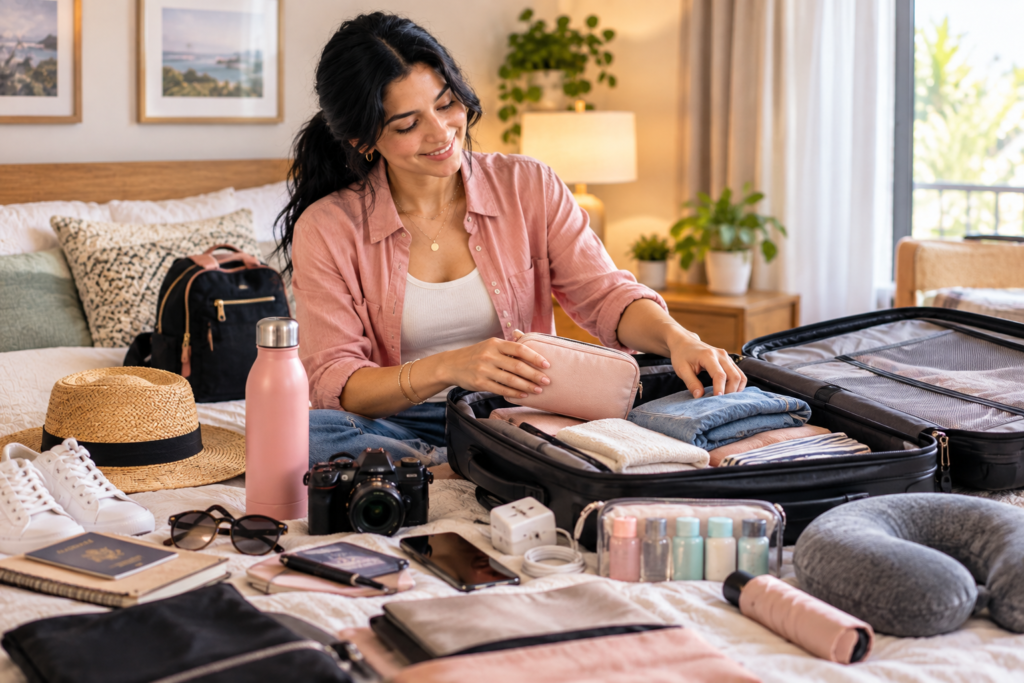
Cubes let you find things quickly without spreading your belongings across a shared dorm or a small room. Use one for tops, one for bottoms, one for underwear and sleepwear, and a small one for electronics.
Luggage tracker
A small tracker tucked inside your suitcase lets you see where your bag is if an airline misroutes it, and gives peace of mind when bags are stored in bus holds or hotel luggage rooms.
Small lock
A combination lock is useful for hostel lockers and for discouraging opportunistic access to your bag on overnight transport.
5. Clothing That Works Hard
Fewer, more versatile pieces make solo packing easier. Choose a color palette where most items mix and match, and research local dress norms before you go — in many places, covering shoulders and knees makes you blend in and is required at religious sites.
- A large scarf or sarong — doubles as a head or shoulder cover, a light blanket on cold buses, a beach towel, and a privacy curtain in a hostel bunk.
- Clothing with zip or hidden pockets so your phone and cash stay on your body.
- One comfortable pair of walking shoes you have already broken in, plus sandals or flip-flops for showers.
- A lightweight rain jacket that packs into its own pocket.
- Quick-dry underwear and a travel laundry kit (a sink plug, a small bottle of detergent, and a few clothespins) so you can pack less and wash more.
6. Health and Personal Care
When you travel alone, feeling unwell is harder because no one can run to the pharmacy for you. A compact kit means you can handle small problems in your room.
- Any regular medication, in original packaging, with a few extra days’ supply in case of delays
- A small first-aid kit: plasters, blister patches, antiseptic wipes, pain relief, and rehydration salts
- Menstrual products you trust, since your preferred type may be hard to find in some regions
- Hand sanitizer and tissues for buses, trains, and public restrooms
- Sunscreen and lip balm with SPF
- Refillable leak-proof toiletry bottles that meet carry-on liquid limits
7. Comfort in Transit
Solo trips often involve long travel days with no one to lean on — literally. These items make overnight buses, trains, and flights far more bearable.
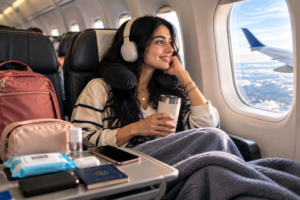
- A travel pillow that supports your neck when you sleep sitting up
- An eye mask and earplugs for dorms, night buses, and thin hotel walls
- A refillable water bottle (empty through security, filled afterward)
- Compression socks for flights over six hours
- Downloaded books, podcasts, or shows, so you’re not relying on transit Wi-Fi
For more on long journeys, read our guide to essential travel accessories for long flights.
8. Habits That Matter More Than Gear
The most useful things on this list aren’t things at all. A few routines make solo travel smoother and safer:
- Book your first night in advance and plan to arrive in daylight when possible.
- Read recent reviews from other solo women before choosing accommodation. Look for comments about the neighborhood after dark, not just the room.
- Know the official taxi or ride options from the airport before you land.
- Keep your accommodation address saved offline and written on paper.
- Trust your instincts. Changing plans, leaving a place early, or saying no is always allowed.
Quick Printable Checklist
Safety: personal alarm, portable door lock or door stop alarm, anti-theft day bag, small flashlight.
Documents and money: passport holder, second wallet, backup card stored separately, paper and digital copies, emergency contact card, pen.
Tech: power bank, universal adapter, spare cable, SIM or eSIM, offline maps.
Luggage: carry-on bag, packing cubes, luggage tracker, combination lock.
Clothing: large scarf, pocketed layers, broken-in walking shoes, sandals, rain jacket, laundry kit.
Health: medication, first-aid kit, menstrual products, sanitizer, sunscreen, refillable toiletry bottles.
Comfort: travel pillow, eye mask, earplugs, water bottle, compression socks, downloaded entertainment.
Final Thoughts
The best solo travel kit is light enough that you never feel weighed down and complete enough that small problems don’t turn into stressful ones. Start with the safety and document basics, add the tech that keeps you connected, and then build the rest around where you’re going.
Once your bag is sorted, the only thing left to do is enjoy the freedom of a trip that is entirely your own. If you’re still planning, our guide on how to plan a budget-friendly solo trip is a good next read.